Ellie Mae

Ellie Mae
Beautiful Ellie Mae

Freddie, the French Bulldog

Freddie, the French Bulldog
Lazing on a sunny afternoon

The artist

The artist
Ollie Mac

Ollie and Annie

Ollie and Annie
Azorean grandmother

Acrylics and watercolors

Acrylics and watercolors
Cannabis and sunflowers

Papa and Ollie Mac

Papa and Ollie Mac
Priorities, Baby

Acrylics and watercolors

Acrylics and watercolors
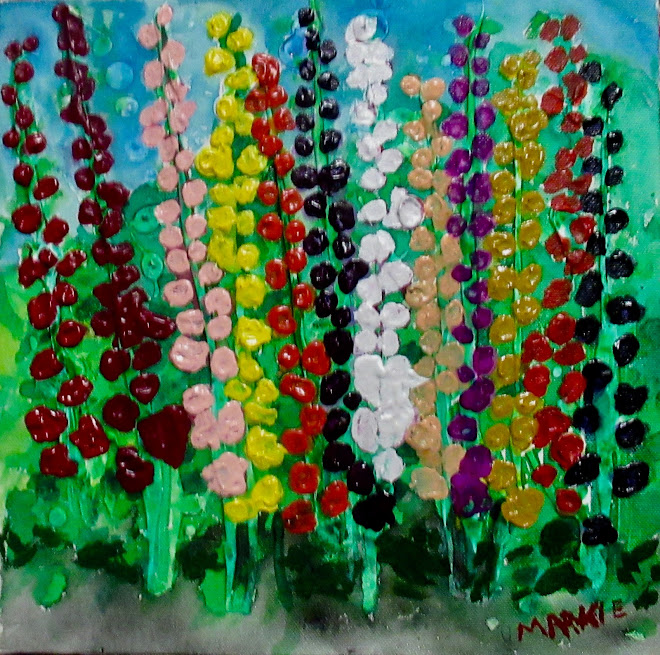
Hollyhocks

Mahlon Masling Blue

Mahlon Masling Blue
My friend and brother.

Mark's E-mail address

bellspringsmark@gmail.com

Tuesday, May 7, 2013

A Lot to Learn


I am working on an A-Z challenge, this one featuring short pieces of fiction.  Today’s letter is S for stuck.

A Lot to Learn

We were stuck.  And I’m not talking about being between a rock and a hard place.  Unfortunately, there were no rocks to be seen-nothing but a sea of mud.  I was with my friend, Will, and we were getting nervous.  My name’s Stanley, but folks mostly just call me Lee.  The rain which beat down on our unprotected heads, as we stood surveying the scene, was merciless.  Why we had ventured out at this particular juncture in time, in the first place, was beyond my comprehension.  I guess you might say we were grasping at straws.  But straws would do no good, in this sea of mud.

Originally, the idea was to get up to Ricky’s place, take care of the business at hand, and get back to Dodge, and all had proceeded according to plan.  But we never realized that the weather could be so extreme.  Being new to the region, recently transplanted up from SoCal, I guess we had a lot to learn.  We just did not have that much experience with dirt roads, especially ones which turned to mud in a driving rainstorm.  Afterwards, we were to learn that the road had been recently graded, leaving the surface susceptible to a muddy quagmire, requiring four-wheel drive to have any expectation of reaching one’s destination.  I knew that if we waited long enough, it would all be good, but time was precious, and we had a long road ahead of us.

Unfortunately, the only form of transportation available to us, had been a little Toyota Camry, with worn tires to boot, and it had functioned as well as we might have expected, until it slid into the ditch, leaving us incapable of going either forward or backward.  It reminded me of the time we tried driving up to Mt. Baldy, in a similar form of transport, and ended up stuck in the snow, when we pulled off the road and tried to turn around.  At least then, we were able to flag down a passing four-wheel drive truck, and get pulled back onto the road, pointed in the right direction.  Here, we had not seen another vehicle at any time in the forty-five minutes since we had left Ricky’s, and with darkness settling over us, we were unlikely to encounter any traffic now.

Any effort at getting our little Camry out of the ditch, was met with spinning tires, and a belch of smoke from the tailpipe, indicating the forward progress was going to require some sort of miracle.  At this time, I would have settled for reverse progress, or movement of any sort, but evidence indicated I should not hold my breath waiting.  Our cell phones provided no service, out in this rural area, so it would probably have to be a land phone.  Out of desperation, I had texted Ricky, letting him know of our predicament, hoping that he would get the message and come to our aid.

Just as it got to the point where total darkness was settling over us, approaching headlights gave us a ray of hope.  It was the first sign of civilization  we had encountered, and at the very least we were hoping to get a ride to a place where there was a functioning phone.  The headlights swept past us, stopped, and then backed up, as the three-quarter ton Ford pickup was put in reverse, until it was even with us.  The driver and his passenger paused, staring at us, as if we were the most bizarre creatures in on the planet.  What was up with that?

“You fellows OK?”  The driver had rolled down his window and was peering out at us, grinning like a drunk sailor.  

I wondered what he thought was so funny, but beggars can’t be choosers.  “Hey, are we glad you stopped!  We’re stuck.  Can’t go forward-can’t go in reverse.  I guess this little Toyota isn’t the best vehicle to drive up here.”

The driver took that in, sneered at us and said, “You think?”  

His buddy in the passenger seat guffawed, loudly and added, “You mean because it’s a little runt of a car, with no four-wheel-drive, and tires the size of a bicycle?”  He derived a great deal of pleasure out of his witticism. 

“You’re probably right about that,” I agreed.  “But right now, what we could use is a hand getting out of the mud, and back into the center of the road, where we might at least have a shot at getting back down off this mountain.  What do you say?”

“I say, the only reason geeks like you, in a car like this, come up to our neighborhood, is because you’re after some lucrative product, grown locally, and you’ve probably just come from somewhere up the road, and are packing anywhere from five to twenty pounds of the good stuff.  How am I doing so far?”  The driver had pegged us pretty accurately, except he was off on how much we had.  Thirty pounds of Train Wreck were stashed, as carefully as possible, in the surprisingly deep trunk of the little Camry, all seal-a-mealed tightly, and ready for delivery to an acquaintance down in Orange County, who had told us he would pay twenty-eight per pound.  Since we had gotten each elbow for eighteen, that meant a cool thirty large.  I was not all that anxious to share this information with the two rowdies now parked right in the middle of the muddy road, smirking at us with contempt.

“I don’t know what you’re talking about,” I exclaimed, figuring I would start with a bit of a bluff.  “We were up visiting my brother, who’s a teacher down in town.  What would I know about any product?”  I emphasized that last word, hoping to convince him that I was just a stranger in a strange land.

“Who you trying to kid?” sneered the driver, showing us that smile again, lopsided due to the missing teeth.  “Ain’t no teacher live up this road.  Only people who live up here are them’s what grow the reefer.  Now why don’t you just open up that trunk and give us a gander as to what kind of reward we can expect, if’n we were to actually get you out of that ditch, and on the way again.”

I was starting to sweat, even though the temperature had dropped precipitously, at the outset of the storm, though I doubted that the two cretins staring at me could tell the sweat from the rain.  Was it possible I could buy my way out of this mess, without losing it all?  

“Look,” I pleaded.  “If you get us out of the ditch, and on the road, sure, we’d be more than happy to turn you on to an ounce of the Train Wreck.  What do you say?”

Without consulting his partner, the driver responded, “I’d say you thought we were a couple of idiots.  Why would I settle for an ounce, when I could just take everything you got, without you being able to do a damn thing?”

I was scrambling now.  “Hey, be serious.  You’d be in a lot of trouble if you ripped us off for all we have.  They put people in jail for that kind of stuff.”

The passenger jumped in now.  “And who’s going to call the pigs?  You?  How do you think they would respond to you having a bunch of reefer?  You think the cops care about someone losing his pot, because he wasn’t smart enough to be able to move it himself?  You got another thing coming to you, Mac.  I think we’re done talking.  Open the goddamned trunk.  Now.”  To make sure that we knew he meant business, he had pulled the rifle off of his Easy-Rider rifle rack, and was holding it nonchalantly in the crook of his arm.

“Whoa!  Easy now.  Can’t you be reasonable?  What did we do to you?”  I was stalling for time.

“You fed us a load of crap.  That’s what you did.  Now you’re gonna to have to pay for it.”  The driver had stopped grinning.  I wish he hadn’t.
Without warning, the dude holding the shotgun, pointed it up at the torrential rain, and pulled the trigger, scaring what little bravado I still had,  right out of me, into the gutter.

“Whatever,” I exclaimed.  “You want our reefer, here’s the key.  Help yourself.”  I wasn’t about to get shot over some lousy money.  OK, the money wasn’t lousy, but I knew when I was beaten.

I tossed the set of keys at him, and figured, easy come-easy go.  For his part, the dude with the shotgun said, “Now that’s more like it,” and he actually put his rifle back into the rack, as his partner snatched the key from me and scuttled around to the rear of the little Camry, inserting first one key, and then another, trying to pop that trunk lid open.  I could tell he was getting frustrated, but was damned if I was going to help him out.  

By the time he finally figured out which was the right key, and got the trunk open, I was already regretting my hasty decision.  But I was also still alive and kicking, which helped balance the ledger.  I stood there in the pouring rain, and watched those two yahoos chortling over my property, knowing I had a snowball’s chance in this rain, of ever being able to regain it.

Therefore, I was flummoxed, when out of nowhere, a voice demanded in no uncertain terms, “OK, you two bozos have had your fun; now put down those bags, get back into your truck, and drive on up the road, or you’ll be on the receiving end of a load of buckshot, with plenty more from where that came from.” There stood Ricky, a sawed-off shotgun pointing right at the mid-section of the gap-toothed driver, his hands steady as the big oak tree, just off to the side of the road.  “Kindly take this opportunity to carefully remove that rifle from its perch, and toss it off the road.  It will be waiting for you in the morning.”

Turn-about is fair play, and I could see the driver of the pickup and his buddy weighing their options.  Ricky advanced several steps threateningly, raised the shotgun to his left shoulder, and sighted down the barrel.  “Was there something about what I just said that you didn’t understand?”

They weren’t the sharpest knives in the kitchen drawer, but they were wise enough to see that being on the wrong end of a sawed-off shotgun, had put them in an awkward position, one that spelled out the second chapter that night of “easy come-easy go.”

They went, without so much as a whimper, which was good because no one likes a whiner, and Ricky was already soaking wet, having parked his rig several hundred feet away, behind a stand of oaks, when he had heard the earlier blast of the thug’s rifle.  He watched as they climbed back into their truck, jammed it into gear, and headed back up the road.

“Well, let’s get you boys back on the road, so I can get out of these clothes, and into a bottle of Bushmill’s.  Sound OK to you?”

Sounded just fine to me.  I made a mental note to not come up on this mountain again, unless I was driving a four-wheel-drive, and with a little Train Wreck, I figured I could avoid another road wreck.

Sunday, May 5, 2013

Something Drastic


I am working on an A-Z challenge, this one featuring short pieces of fiction.  Today’s letter is R for risky business.

Something Drastic

Stu joined Tony at a table to the rear of the Hickory Horse, just off the kitchen, plunking himself down in the booth, and settling into the well- worn cushion.  He sighed, reached over to the menus placed along the wall, selected one and opened it, signaling to Sophie at the same time, that they were ready for cold ones.  “Where’s Jerry?” he asked his booth mate, though how Tony was supposed to know was beyond him.

“I expect he’ll be along shortly.  Probably had a late customer, and couldn’t get free.”  Jerry worked in a motorcycle shop, one which provided parts, in addition to selling the bikes themselves.  The three of them ate their evening meal together, five or six nights a week, and had done so for close to ten years now.  None of the three was married, and the prospects were not good.  Even when he was married to Rita, Stu had still eaten at the Hickory Horse, because Rita worked from three to midnight and therefore, Stu had to fend for himself for dinner.

As they perused the nightly specials, they were joined by Jerry, who remarked as he sat down, “I never understand why these freaking people have to walk into the shop at five minutes before closing.  It’s enough to drive me to drink,” signaling to Sophie that a cold beer was in order.  Stu and Tony ignored him; it wasn’t as though they hadn’t heard the same thing a hundred times before.  Any advice either of them had to offer, had been offered a dozen times in the past.  Offered and rejected.

Sophie sidled over, setting down their beers, asking as she did so, “Are you decided yet?  The salmon’s just in, and we won’t have it for more than a wink, so’s you’d better jump while the jumpin’s good.”  Sophie had been there forever; she could have predicted their orders for them, if she’d a mind to it.  They placed their orders, none of them “jumping” on the salmon.  

They used to come to this restaurant during high school, scarfing their cheeseburgers and fries, after the Friday night football games.  Stu could even recall his birthday, when he was in eighth grade, and been allowed to invite eight of his friends to have a birthday lunch together.  Yes, they went back a long way, this restaurant and the three of them, even if it was beginning to list to the shabby side of things.  The candy-apple-red curtains were faded; the tables were mismatched, and the booths had benches that were sadly in need of reupholstering.  But the Hickory Horse was still the best food joint in town; make no mistake about that.

The place seemed to always have the tables occupied, but there was still rarely a delay getting one.  It was the perfect balance of quality, without being compromised by quantity.  As they sat there sipping and going over the events of the day, they became aware that there was a one-sided conversation, going on in the kitchen, with the gravelly voice of Vic, the owner of the Hickory Horse, being easily recognizable.  He had a desk just inside the kitchen, which served as an office away from his office.  Vic spent a lot of time in the kitchen, and was known to both give and take advice from the chef.

“Well, it ain’t like I want to, you know?  Hell-raising horse...  I just can’t afford to keep going on like this.”  Vic was one of the reasons they ate at the Double H, as the restaurant was often referred to.  He had coached their high school baseball team and was a big part of the hierarchy of the town.

Jerry started to comment, but was quickly shushed by Stu and Tony.  “I want to hear this,” Stu whispered impatiently.

Whoever Vic was talking to made a comment, to which Vic said, “I lost another grand last week, and what with the electricity bill double what it was a year ago, I just can’t afford it.  I tell you I’m gonna have to do something drastic.”

Tony whispered urgently, “Vic’s going to shut down the Double H?  What the hell?”

Vic continued, “I thought for sure I could pull it together, but now I’m seeing the truth.  It’s such a risky business.  I used to have the knack, but now...I just don’t know anymore.”

“This is bad,” Tony muttered.  “If he shuts this place down, I’m going to end up at The Pizza Butt, or worse, McDonald’s.  Good God-is nothing sacred?”

“Well,” said Stu, “I’ll talk to Vic, though I don’t see how I can make a difference.  I mean, I can lend him money, but you heard what he said, the same as me.”

“Yeah, I heard it; I just don’t want to believe it.  Do you think someone else will take over and make it happen?” queried Tony.

“Not the way it happens now.”  Jerry’s voice had a note of finality in it.

The conversation from the kitchen put a damper on the meal.  They ordered another round of beers, but refrained from asking Sophie what she knew.  After all, Sophie never got it right.  As they got ready to pay the bill and leave, Vic came out of the kitchen and settled in his customary place at the end of the bar, drinking a beer.  

Stu ambled over to him and said, “Hey Vic.  Sure did enjoy my steak tonight.  Don’t know what I’d do if you ever shut this place down.”

“Well, hey Stu.  Glad you liked it.  As for shutting the place down-ain’t never gonna happen.  Why would I do that?  Here, let me buy you a beer.”

“What?  You’re not thinking of closing this place?”

Vic snorted.  “Shut down the Hickory Horse?  Why in the Sam Hell would I do that?  Have you lost your marbles?”

“Well, we heard you talking before...”  Stu’s voice trailed off.

“Heard me talking?  Hell, I yak all day.  What’s that got to do with closing this baby of mine?”

“Before, when you were in the kitchen.  You told someone, ‘I can’t afford to keep going like this.  I’m going to have to shut it down.’”

Vic leaned back, almost falling off the bar stool, he was laughing so hard.  “When I said shut it down, I was talking about my yen for betting on the ponies.  I can’t win and I’m tired of losing.  I’ve just been doing it for so long that I don’t honestly know if I can stop.  But I’m not going to shut down the Double H.  Hell, where would I eat?  McDonald’s?”

He leaned over the bar and hollered at the barkeep, “Hey, Benny, get Stu, here, another beer.  And while you’re at it, get me one too.  I need it!  Sell the Double H?  That’ll be the day!”


Saturday, May 4, 2013

Do Something!


  I am working on an A-Z challenge, this one featuring short pieces of fiction.  Today’s letter is Q for quarry.

Do Something!

We were parked a few hundred feet down from the quarry, and had gotten out of the car, and ventured over to the water’s edge, just as we had done so many times before.  They said that it was a bottomless pit, but that was hyperbole.  There was a bottom; we just couldn’t see it.  The water was as cold as the ice water which refreshed us in the heat, as we walked in the blistering sun, determined to get to the back side of the pool, where the rocks, towering overhead, provided the essential shade needed to make the whole trip worthwhile.

The quarry, quiet and somewhat mysterious, had been our go-to spot, ever since we had gotten together, more than a year before.  I was with my girl, Sonny, short for Sonja, and we were not there to talk.  If we had wanted to talk, we could have stayed back at the school where we both attended.  No, what we wanted was privacy, even if it meant clambering over rocks, maneuvering our way back and through some treacherous spots, to reach the little alcove about fifty feet up from the water’s edge.  There, miraculously enough, we would find a little oasis from the hard granite surface which dominated the quarry, in the form of a tiny grassy niche, just big enough for six or eight kids to congregate, when the heat got to the unbearable stage.  Only there weren’t six or eight of us; there was only Sonny and I.

At least, that was my plan.  I was hoping that it was Sonny’s plan also, but from the way she was chattering, I was beginning to have my doubts.  After all, a person tends to prattle on when she is uncomfortable, not the other way around.  Companionable silence only accompanies those who are ready for it and that takes time.  Settling into our little spot, I felt that things were going just the way I had planned, so I put my arm around her and gave her a lingering kiss, one intended to shift the environment from casual chatter to the sounds of silence.

But no sooner had I planted that intention, firmly in both our minds, than we became aware that we were not alone.  A distant car door slammed, as we surfaced for air, and we held our breath, as we waited to see what this might mean.  We didn’t wait long.  Below us, another young couple moved into the arena, walking gingerly amongst the boulders strewn throughout the quarry, making their way, right to the water’s edge.

“Are you sure this is what you want?” we heard the young woman inquire of her partner.

“Yes,” he responded emphatically.  “This pool is bottomless; no one can see what ends up on the floor.  I’m tired of being up all night, every night.”  The young man, probably no older than I, seemed anxious to complete his mission. 

He held a bundle in his arms, seemingly caressing it, as he stood at the water’s edge.  For my part, I was highly agitated.  What was in that little bundle?

“I know what you mean; maybe we’ll get a decent night’s rest, for once.”

The bundle was weighted down by a heavy chain, ensuring that it would plummet to the floor of the pool, never to be seen again.  Of what were these people trying to rid themselves?  I was getting very angry.

The young man spoke again.  “At first things were great and I felt I could handle it, but lately all I do is think about what it used to be like.”

Listen buddy, I thought to myself.  You better get a grip on reality; you don’t just dispose of your responsibilities so frivolously.

“Tell me about it,” the young woman replied.  “The racket is intolerable, and I feel so drained every morning.  This is best.”

Sonny was clutching my arm.  “Do something!” she hissed at me.  Great.  I was supposed to be the hero here.

“Maybe there’ll come a time when we’re better ready for this, but I think it’s obvious that the time is not now.  We both need to be able to focus on our jobs, and that can’t happen with...” The young woman’s voice trailed off.

“So, you don’t think this is too extreme?” her partner asked?

Well, I thought it was too extreme.  I jumped up and hollered out, “Stop!  You aren’t alone here, and if you throw that tiny bundle of joy into the pool, I will personally make sure that the whole world knows what you’ve done!”  There, I had done it now.  What next?

Startled, the couple stared up at me in bewilderment.  From the expressions on their faces, I realized that I had just stepped in it, big time.  “Who are you?” the young man demanded, “And why do you give a rat’s backside what we’re doing?”

I was beginning to have serious second thoughts.  For them to react so self-righteously, there had to be a misunderstanding.  I responded, “Because I care, and I can’t let you get away with it,” I blurted out, and then stopped.  “What’s in the bundle?”

“Not that it’s any of your business, but it’s my ten-speed blender.  I don’t need this in my life, right now.”

Damn!  Neither did I, but I sure needed a drink.  Make it Jameson on the rocks, and go ahead and dump that blender into the pool.  I won't tell a soul...


Wednesday, May 1, 2013

Wrong Sport


I am working on an A-Z challenge, this one featuring short pieces of fiction.  Today’s letter is P for the past.

Wrong Sport

Herman and Raul sat on the park bench, in the spring sunshine, in  companionable silence, content to take in the activity around them, without having to make empty conversation.  They met together every day but Sunday, to wile the time away, no longer having the energy nor the desire to spend time in the work force.  They read their respective newspapers, sipped tea from their thermoses, and watched the seasons change and the patrons of the park walking, running and laughing.  Herman’s cane resided alongside them, used only for the occasional trip to the concrete restroom, located a short distance away.  They sat in the sun  and they watched what was going on around them.  Isn’t that what oldsters are supposed to do?

For the most part, the park produced no surprises.  It was predictable, lightweight and served as the perfect backdrop for two old guys who had spent a lifetime at the grindstone.  Herman had worked as an automotive repairman, and Raul had worked in a factory.  Herman still carried the same satchel that he had taken with him every day to work; it sat beside him on the bench.  Neither man was made out of money, but neither one would starve.  As they watched the parade of activity stream past and around them, they felt a certain protectiveness over the youth who shared their spot.

There was a basketball game over on the blacktop; there were younger kids on the swings and slides, and there were couples strolling along, hand in hand, arm in arm, pausing now and again to revel in each other’s company, and there were various others there, enjoying the same spring sun.

This morning brought a new element to the park.  A car, metallic green, polished and shiny, souped-up engine throbbing evenly, on the other side of the park, drew their attention.  Neither had ever laid eyes on it before.  Four doors opened, four young men emerged and four doors slammed shut, as the quartet made its way into the center of the park, seeking out one of the many picnic tables, where they perched themselves, not on the benches, but on the table itself.

They lit up a cigarettes, puffed away, and made raucous conversation, the sound of their laughter drifting across the park, mingling with the rest of the hum of activity, no one paying particularly close attention to this arrangement.

Today, there was a touch football game in progress, the participants somewhere around middle school age, with the kind of limitless energy this age group was want to display.  The game was lively, the passes heaved well down the field, and the players greeted each successful play with hoots and hollers of delight.  This is exactly why this park was built; it gave so many people the option to create their own diversions, without having to resort to hanging on street corners, brewing up trouble, because there was nothing better to do.

What drew Herman’s attention to the scene was an errant ball, which had been kicked by one of the scoring teams, but had been shanked to one side, ending up taking a crazy bounce, and striking one of the four young men, right on the side of the head.  This wasn’t a case of the ball causing pain; it was merely that it startled him, and drew the derisive laughter from the other three.  Without preamble, the guy who had been hit, jumped off the picnic table, ciggie still dangling from his lips, and pounced on the ball, retrieving both it, and his former spot on the table.  He held the football, without any indication that it was not his, ignoring the pleas from the kids whose game had halted uncertainly, waiting for this new development to play out.

One of the kids hollered out, “Hey! Give us back our football.”  There was no response from the guy on the table.

The players gathered together for a quick conference, before one again shouted, “Hey that’s our ball!  Give it back!”  They waited expectantly.

“Make me.”  It wasn’t shouted, just put out there in little more than a conversational tone, and the two words hung heavily in the air.

“Uh oh,” muttered Raul.  “Trouble in the attic.”  

Beside him, already sitting upright taking in the new development, Herman grunted, spat, and said, “What those creeps want to go and hassle those kids for?  All they doin’ is playing some ball.  I got news for them scumballs.  This park don’t belong to them; it belong to us.”

Raul nodded in agreement.  “But who’s gonna stop ‘em?  Us?”  He laughed.  “Maybe in our younger days.  But those days is past.  And we ain’t gettin’ any younger.”  He smiled ruefully.

Herman grunted again, and just for good measure, spat.  “Ole Hank gonna stop ‘em.  You know, Hammerin’ Hank.”  He nodded.  “Yep, it may just be time for Hank to lend a hand.”

“Are you crazy?” his friend asked.  “Hank Aaron?  What’s he got to do with the price of chickenfeed?”  Raul was shaking his head slowly, from side to side, thinking his old buddy had been dipping into the meds a little too liberally.  Or something, anyway.  He voiced his opinion.  “Have you been smoking the shit?  You rambling like you got the Alzenheimer’s crap.”

“It’s Alzheimer’s, and I may have it, but I also have Hank.”

“Whatever.  Wait...what they up to now?”

The guy with the football had tossed it to one of his pals, who had flipped it back to the first guy, and they kept that up for the next couple of minutes.  The kids had gathered together in a group, talking amongst themselves, but doing absolutely nothing.  After watching the older guys, one of the kids, the one with the strongest arm, approached and asked, “Hey, can we have our ball back, please?”

The guy who had been hit, said, “Please?  Do I look like your grandmother, that I’m going to be impressed with the word ‘please?’”

“Look, Mister.  We just want to play ball.”

“Well, maybe you should have thought about that before you started hitting bystanders with the ball.  So, no.  You don’t get the football back ‘cause it’s mine now.”

With that, Herman stood up, grabbed his cane, and headed over towards the picnic table. “Hey, Raul.  Bring my satchel.”

Raul shrugged and stood up.  “Yes, Master, whatever you say.”  He followed Herman, gradually catching up to him.

Herman wished he could sprint over to where the football was, but he told himself that he was moving as fast as he could and that everything comes to him who waits, especially old age.  As he neared the table, he caught the eye of the guy who was causing the trouble.  The guy asked, “What do you want, old-timer? You coming to take this here ball from me?”

“No, I won’t need to do that, because you’re going to give it back on your own.”

Whatever the guy had thought the old man would say, when he saw Herman come up, it was not that.  “Now why would I do a dumb-ass thing like that?  Oh, I see, your friend is going to make me.”  He snorted with contempt.

Raul had stopped beside Herman, offering him the satchel.  “Actually, no,” said Herman.  “Raul, here, is not going to make you, but my friend, Hank, is.  I call him Hammerin’ Hank, and he’s very persuasive.”

The guy laughed derisively.  “Hammerin’ Hank?  We ain’t playnig baseball; we playin’ football.  Go back to your bench.”

Standing where they were, the kids who had been playing football, could not see what was going on, because the table with the three others still sitting on it, blocked their vision.  So they did nor see when Herman reached into his satchel, pulled out a .357 Magnum, and pointed it right at the guy with the football.  There was no doubt that Herman had his undivided attention.

“My bench will be there when I get back.  But you may not be.  Now, you’re going to return the football to those kids, you’re going to get into your Shiny green slime-mobile, and you’re going to leave.  If you don’t I will put a .357 slug right into your gut.  I may not kill you, but I damn sure will put you out of commission.  Do I make myself clear?”

“If you shoot me, then you’re going to end up in a world of hurt.”

“That’s not your problem.   Hammerin Hank is your problem.”  Herman kept the weapon trained on the guy’s chest.

Trying once more to bluff his way out of it, the guy said, “Why would you do something like that?  You’ll spend what’s left of your life in prison.”

“I’d do something like that because I don’t like your kind.  You come here, you bully kids, and you think you can call the shots.  But you’re wrong.  And you may be right about me spending the rest of my life in prison, but since I got less than six months to live as of two months ago,  nothing scares me right now.  Just give me a reason to shoot you, and see how long I hesitate.  Now give the football back to the kids, get in your car, and leave.

Apparently Herman had made his case.  The guy shrugged, threw the football in the general direction of the kids, and started walking away.  The others rose, one by one, and followed him, without looking back.

The kids were ecstatic.  “Hey, thanks, Mister.  How’d you get him to give us back our football?”

Herman smiled and said, “I told him Hammerin’ Hank would not appreciate it if he kept your ball.”

The kids looked around and asked, “Hank Aaron is here?”

Herman laughed and said, “Well not anymore.  He left when the creep did.  After all, you’re playing football, not baseball,” and he turned and headed back to his bench.  Raul followed, shaking his head in amusement.  “You’re something else,” he said.  “I’m not sure just what, but you are something else.”

Tuesday, April 30, 2013

Under the Apple Tree


I am working on an A-Z challenge, this one featuring short pieces of fiction.  Today’s letter is O for Overpass.

Under the Apple Tree

As she stood on the overpass, gazing downward, Harmony felt the despair washing over her again, insurmountable, overwhelming and irresistible.  The opening in the chain-link fence beckoned her, welcomed her, and embraced her, assuring her that the free flow of vehicles below her, would do the trick instantaneously.  All she had to do was to take that last step.

Who had cut the fence in the first place?  Harmony didn’t know and she didn’t care.  All she knew was that it would suffice.  All of her pain and all of her depression would be eliminated in an instant, and calm and serenity would descend upon her like a veil of fog.  A big-rig lumbered past, below her, vibrating the overpass, and once again she thought how quick and efficient the whole process would be.

She thought about the kid who probably had used the heavy-duty wire cutter to cut the aperture in the barrier.  Was it a prank?  Were they throwing oranges?  Were they having fun?  Did he have any idea that someone else might see the gap in the barricade as something other than a moment of excitement, an opportunity to entertain?  She doubted it.

For a moment she pondered the events leading up to this ultimate decision.  The breakup, the divorce, the heartache leading to her decision that she no longer cared enough to continue down the path of life by herself.  Her friends told her that there would be others; in her heart she felt they were wrong.  What she had lost was beyond description.  She had given her soul away; there was no regaining that.  There was nothing left for her, but to take that last step.

She stepped forward, positioned herself to take the fatal plunge, and stopped, suddenly aware that she was being joined on the overpass by a second person, a little girl skipping along merrily, alternately singing and humming a little ditty, that sounded vaguely familiar.  The little girl had appeared out of nowhere; the song she was singing was, “Don’t Sit Under the Apple Tree [with Anyone Else but Me...].”

“Hi, what are you doing?”  The little girl, not more than third or fourth grade level, looked up at her with a rosy smile.

“I’m... nothing.  I’m just watching the traffic go by,” Harmony answered, automatically.  What was she supposed to tell this sweet little girl?  I’m going to kill myself?

“Do you like the song I’m singing?  ‘Don’t sit under the apple tree, with anyone else but me...anyone else but me, anyone else but me.  Don’t sit under the apple tree with anyone else but me, till I come marching home.’  My mama used to sing that to me.”

“Oh.  Well, that’s nice.  Did she ever sit under the apple tree with you?”  Harmony could not ignore the little free-spirited sweetie.  The little girl had her hair in pig-tails, and her face was brushed with freckles, and she looked so happy with her beaming smile.  Oh, to be that carefree, again.

The little girl’s smile dimmed. “Yes, all the time.  We sat on the little bench that Daddy made for us.”

“That must have been nice.  I don’t have an apple tree handy.  I live in an apartment, by myself.”  Harmony reflected on the three weeks she had resided in her new apartment, devoid of any wall hangings, devoid of any life.

“We have an apple tree.  See it?  Over there where all that green is?  I wish I could sit under it again with my mama.”  A cloud passed over her face, rearranging her features, wiping out her smile.

“Why can’t you sit under the apple tree with your mama?”  Harmony was too caught up in her own world to see what was coming.

“My mama is up in heaven.  That’s what my daddy says.  But I shouldn’t be sad, because there was nothing we could do.”  The little girl came up to Harmony and held her hand out towards her.  “Will you come and sit with me?”  

And then Harmony knew that there was something she could do.  She could get the hell off that overpass, and sit under the apple tree, with someone who cared enough to invite her.  “Sure, Honey.  I’d love to sit under the apple tree with you, but only if you’ll sing your song again.”


Monday, April 29, 2013

Armed and Dangerous


I am working on an A-Z challenge, this one featuring short pieces of fiction.  Today’s letter is N for Next Time.

Armed and Dangerous

Nora sat up with a start, her hands clammy, her nightshirt soaked in sweat.  The wail of a siren in the distance was not the reason she had awakened.  It was still black as charcoal, without a breath of air movement, even though she had left her bedroom window open.  The heat had been so oppressive last night that she had taken the extra step to open that second, little-used window, that looked out from the hallway at the dreariness behind her third floor apartment.  As she sat, hardly daring to breathe, Nora realized she was not alone.

There it was again.  The sound was distant, as though someone were flailing his arms in the air, creating a vibration, rather than actually producing that which could be picked up by her hearing.  Her long hair was strewn over her shoulders, and hanging every which way, as she leaned forward to better determine the source of her fear.  Her neck was beginning to ache, as she cocked her head to one side to allow the left ear better position to take in any sound.  Her left side was her dominant side, and she always deferred to it, but this time it did no good.

Her mind leaped backward, to that bulletin interrupting her television program last night, warning that there had been a breakout from the prison, located less than seven miles away, the one where repeat offenders were housed, the one that was supposedly inescapable.  She remembered the phrase “armed and considered dangerous” being repeated more than once.  But how would that have any effect on her? And did she dare flick on the light?  Not yet, she decided.  No sense in giving him any advantage.

After all, she was on the third floor, and she had double-bolted her front door.  She didn’t even have a back door; in order to get out of her apartment to the fire escape, she had to go out the one and only door at the front of her tiny quarters.  And yet, there was that sound again, this time almost loud enough to be described as a scratching or chafing. What unnerved her the most was that it was unmistakably emanating from within her room.  

WIthout warning, something brushed against her arm, which had been in the act of trying to gather some of her errant hair, to pull it back behind her.  Something had grazed that arm and it felt as though someone were walking across her grave.  She shuddered violently and involuntarily gasped.  She struck out with all of her strength with her left arm...and encountered nothing.  This was too much!  Too much fear, too much stress, and too much terror.  

Operating on sheer will power, she stood up, letting her hair fall, and dashed across the room to the door into the kitchen, where the only thing she could think of was to grab a broom.  Exactly what good that would do, was not even on the table for discussion.  She just knew that if there was going to be a confrontation-how could there not be?-she didn’t want to be empty-handed.

And then suddenly, something was in her hair, struggling, yanking terrifying her, as nothing had ever done.  Instinctively her hand went upward, and she shook her head violently, racing for the overhead light switch, and flipping it upward, just as whatever it was relinquished its hold, and sailed on its way.  Gasping, sobbing, trying to take in adequate air, Nora gripped her broom and swung it like a baseball bat, connecting solidly, and hitting the proverbial home run. 

The only sound she heard was a solid thud, as the missile sailed forth from her weapon and hit the wall.  Sucking in oxygen, she picked up a discarded washcloth and escorted her unwanted visitor out the same way it had entered her space, with a flick of her left wrist.  She made a mental note to acquire a fan, so that the next time it was hot, she would not have to open that seldom-used window, through which her assailant had entered.  Damn bat flying around her room!  Scared the crap out of her!

Saturday, April 27, 2013

The Unauthorized Pet

I am working on an A-Z challenge featuring short pieces of fiction.  Today's letter is M for mustache.  This short piece is an excerpt out of "Rat Fuzz," part of my "Military Madness" work.


The Unauthorized Pet

So it was that, when I went to have my picture taken for my military identification at Fort Leonard Wood Missouri, in 1972, I still had a mustache.  The guys clipping hair (actually they were shaving heads, and it took them all of about sixty seconds apiece)  were not paid to notice facial hair.   Since Drill Instructor Gaines had vacated the premises with his platoon in the interim I had been gone, there was no one who now seemed to care one way or another whether I had a mustache.  That was then, but the following morning, when we were at parade rest after having come from the chow hall, I drew the notice of Drill Instructor Stephen C. Fletcher, our junior drill instructor, who couldn't have been more than twenty-three.

DI Fletcher was not a big man, but his physique reflected the fact that he was in the best possible shape a guy could be in, an obvious result of working at a job which required tremendous physical stamina, and a tenacious approach to the habitually frigid environment in which we all existed.  He stood about six feet, and weighed around one eighty, with a compactness about him that suggested that in an endurance race, he would outlast anyone.  He was as light on his feet as Muhammad Ali, and his “Smokey the Bear” hat was tipped slightly forward in a jaunty sort of manner that belied his intensity. 

Stopping in mid-sentence of his outline for the day's agenda, he directed his gaze at me and stared.  His eyes widened and he extended his index finger and crooked it toward himself, in the unmistakable gesture that means, “Front and center, Trainee.” 

When I had scurried up to the front of formation, and positioned myself in front of him at attention, he stood transfixed and ogled my face.  
“What is that on your lip?”  
Uh-oh.  I  had a real bad feeling about my hasty decision to follow Drill Instructor Gaines's instructions so literally.  He had told me to shave the “rat fuzz” off of my chin, but had said nothing about my upper lip. “Nothing, Drill Instructor!”

His face began to turn pink.  “Nothing?  Are you telling me that there is nothing on your upper lip, except snot?”
“No Drill Instructor!”
“NO?” he bellowed.  “No?  Then, tell me Private O'Neill, is that a G*******ed caterpillar?  Do you have an unauthorized pet in my platoon, Private O'Neill?”  His face began to turn red.
“NO! Drill Instructor.”
“Well, now, I just think you do, because I can see it crawling there on your upper lip.”
“No Drill Instructor!”

“If that is not a caterpillar, what is it?”
“It is a mustache, Drill Instructor.”
“Were you issued that mustache, Private O'Neill?”  
All of this was happening at warp speed, and I never do well in the spotlight, but still I could see that DI Fletcher was enjoying himself.
“Yes, Drill Instructor.”

That wasn't in the script.  “Who issued you the mustache?”  Parry, thrust.
“Drill Instructor Gaines issued me the mustache, Drill Instructor Fletcher.”
DI Fletcher's eyes went from amused detachment, to amused interest.
“What do you mean Drill Instructor Gaines issued you a mustache?  That is a load of shark s**t.”

“I mean that DI Gaines specifically ordered me to shave the whiskers off my chin, but he did not order me to shave the whiskers off of my upper lip.  Drill Instructor!  According to the company clerk, once your military identification picture has been taken with the mustache, it's part of your I.D. and it can't be required that I shave it off.”  Ah, the perfect application of the nebulous passive voice.  Note that I didn't tell Drill Instructor Fletcher that he couldn't tell me to shave it off, only that I couldn't be told.

Yes, I was a smart-mouthed trainee, a slimy newcomer to his world, and a short-time visitor at that, but I had tickled his funny bone, and that was a key factor in determining the success or failure of any given day for DI Fletcher.  He liked humor, and he appreciated it when it was presented to him, as long as it was not perceived by the troops as humor.   It was important to him to have an appreciative audience for his wit.  It was a mutually beneficial arrangement, one that was to come into play a great deal in the following nine weeks.

“You are the one who came in with the beard,” he mused. Unconsciously, he brushed the fingers of one hand across the neatly trimmed mustache on his own face as he studied the razor cuts and burns on mine.  “How'd that work out for you?”
“Pretty well, Drill Instructor.  I got a mustache issued to me.”